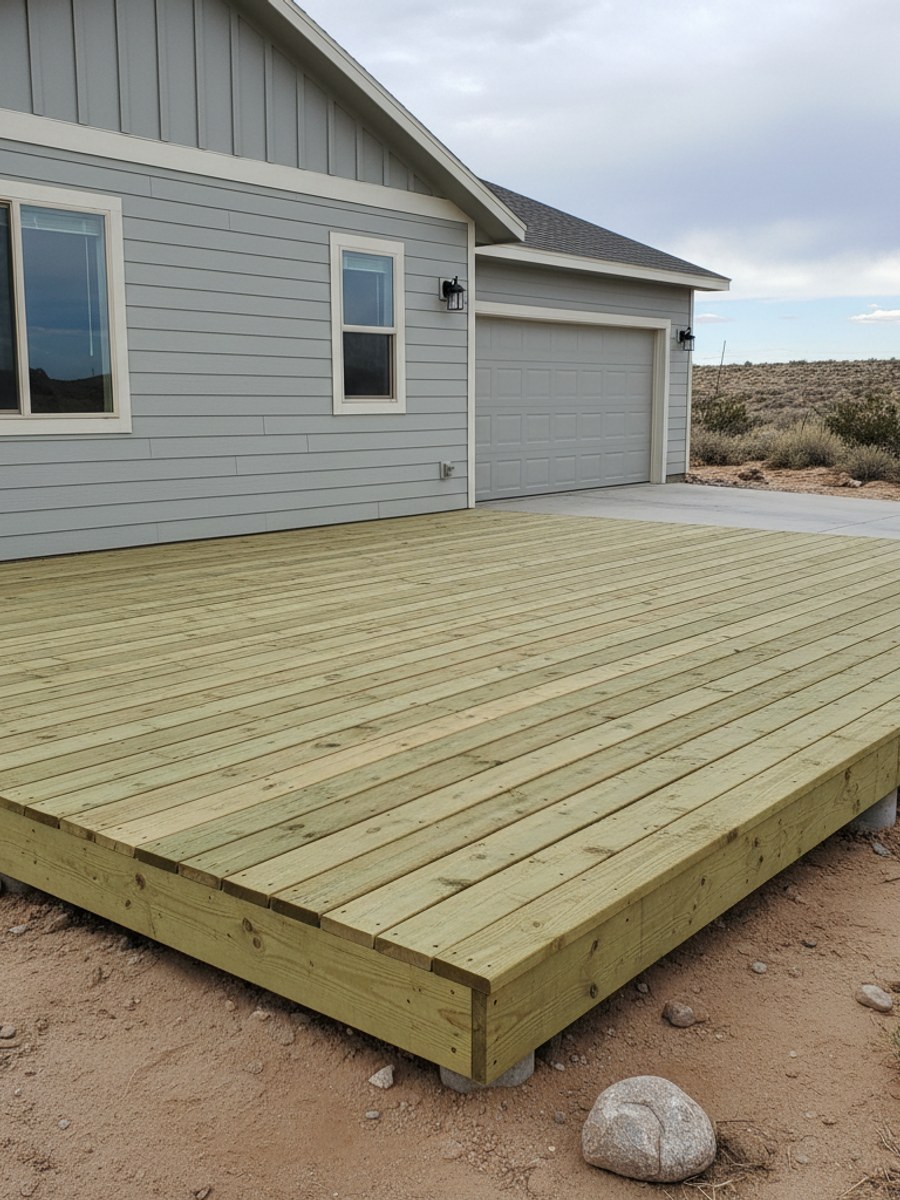
Henderson has a lot of decks going up right now, and a lot of decks quietly failing behind houses built in the late 90s and early 2000s. Picking the right builder matters more here than in a lot of places, because the ground, the heat, and the HOA paperwork all work against a sloppy job in ways that don't show up until year three or four.
Ask who's pulling the permit, and don't accept "we don't need one"
Most raised decks in the City of Henderson need a building permit, and if the deck is attached to the house or more than about 30 inches off grade, an inspector is going to want to look at the footings and the ledger board attachment before you ever put a board down. A contractor who tells you permits are a waste of time, or that they'll "handle it later," is telling you they'd rather not have anyone checking their work. If you're in a community with an HOA, and in Henderson that's most of them, Anthem, Green Valley Ranch, Seven Hills, MacDonald Highlands, you'll also need architectural approval before construction starts. A builder who's worked here before knows the drill and has the submittal package ready. One who hasn't will burn your first month finding out the hard way.
Ask how they're handling footings in this soil
Dig down more than a foot or so almost anywhere in the valley and you'll hit caliche, a hardpan layer of calcium carbonate that's basically cemented itself together over thousands of years. It doesn't compress like clay and it doesn't drain like sand, it just sits there like concrete until you break through it. Post footings for a deck typically need to go 18 to 24 inches deep depending on the design and local frost requirements, which in Henderson are minimal since we get maybe a handful of nights below freezing each winter. The real work is getting through the caliche layer cleanly instead of setting a post on top of it. A builder who's done this before will mention it before you ask. One who hasn't might hit that layer, decide it's "good enough," and pour a shallow footing that shifts the first time we get a heavy monsoon storm and the ground around it saturates.
Talk about materials with the actual climate in mind
Henderson summers aren't kind to a deck. We regularly see 45 or more days a year over 100 degrees, and UV exposure at this elevation and latitude is intense even in spring and fall. Untreated or poorly sealed wood will gray and crack within a couple of seasons. Composite decking holds up better against sun and heat, but even composite boards need gaps sized correctly for thermal expansion, because a board that's 16 feet long can grow and shrink noticeably between a 115-degree July afternoon and a cool January morning. If a builder is quoting composite installation without mentioning expansion gaps or fastener spacing, that's worth a follow-up question. Wood decking still has its place, especially for a traditional look, but it needs a real staining and sealing schedule here, not a one-time coat at installation.
The other thing our summers do is bake out any stain or sealant that wasn't rated for high UV exposure. Ask what product line they use and whether it's meant for desert climates specifically, not just "outdoor use." There's a real difference.
Watch for these red flags
- A bid that's dramatically lower than two or three others for the same square footage and materials. Someone's cutting a corner, and it's usually the footings or the fasteners, neither of which you can see once the decking is down.
- No mention of a written contract with a payment schedule tied to actual progress, not a big deposit up front before any material shows up.
- Reluctance to give you a certificate of insurance. Ask for it directly and call the carrier if you want to confirm it's active.
- Vague answers about ledger board flashing on an attached deck. Water getting behind an improperly flashed ledger is one of the most common ways a deck rots from the house side out, and you won't see it until the damage has already spread into the rim joist.
- No plan for grading and drainage under and around the deck. Henderson lots are mostly flat by design, and when the monsoon season hits between July and September, a poorly graded yard can pool water right at the footings if nobody thought about where it goes.
Older neighborhood or new subdivision, the job looks different
A deck project on an older street, say around the Water Street District or Pittman, often means dealing with a deck or patio structure that's already there and needs demolition first, plus utility lines and irrigation that weren't mapped as carefully when the house went in. A build in a newer subdivision like Cadence or Inspirada usually means working around stricter, more current HOA design guidelines, and soil that's been more heavily compacted during development, which actually helps with footing stability. Neither is harder exactly, but a builder should be able to tell you which set of problems they're planning for before they start digging.
What a decent quote should actually include
Look for footing depth and post spacing spelled out, not just "per code." Look for the fastener type, since hot-dip galvanized or stainless hardware matters more here than in a humid climate people assume needs it more, because heat cycling loosens bad connections over time too. Look for a joist spacing number, usually 16 inches on center for composite unless the manufacturer's span tables call for tighter spacing, which some do. And look for a line item on cleanup and haul-off, because deck demolition debris adds up fast and shouldn't be a surprise on the final invoice.
None of this needs to be complicated to get right, it just needs someone who's actually built decks in this valley, not somewhere else. If you want to see how we spec footings, materials, and drainage on a Henderson deck, Premium Deck Solutions has been doing this work in the area and can walk you through it before you sign anything.